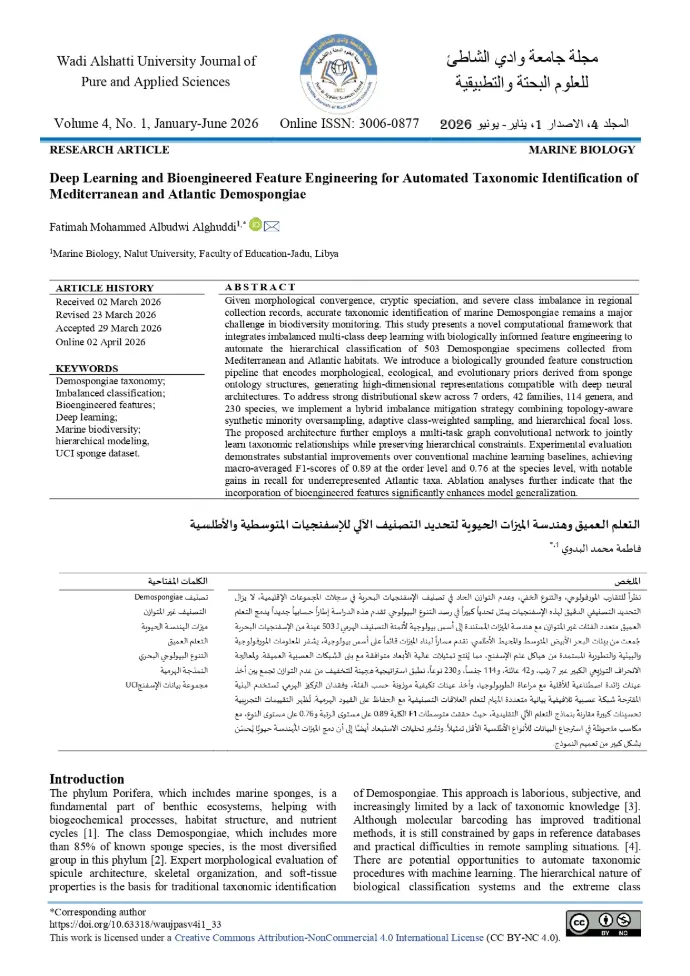
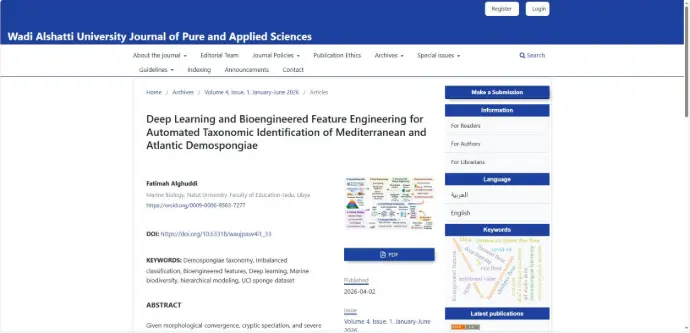
Jadu College of Education, Nalut University enhances its presence in peer-reviewed scientific journals with a distinguished research on the classification of marine sponges using deep learning techniques.
By the grace of God and His guidance, we congratulate the distinguished researcher "Fatima Mohammed Al-Badawi Al-Ghadi," a faculty member in the Department of Biology at the College of Education - Jadu, on the occasion of the publication of her new research paper in the "University of Wadi Al-Shati for Pure and Applied Sciences" journal, Volume 4, Issue 1 (January-June 2026).
Article Title
"Deep Learning and Bioengineered Feature Engineering for
Automated Taxonomic Identification of Mediterranean and Atlantic Demospongiae" "
(Deep learning and feature engineering for the automatic classification of Mediterranean and Atlantic sponges)
Summary of the article:
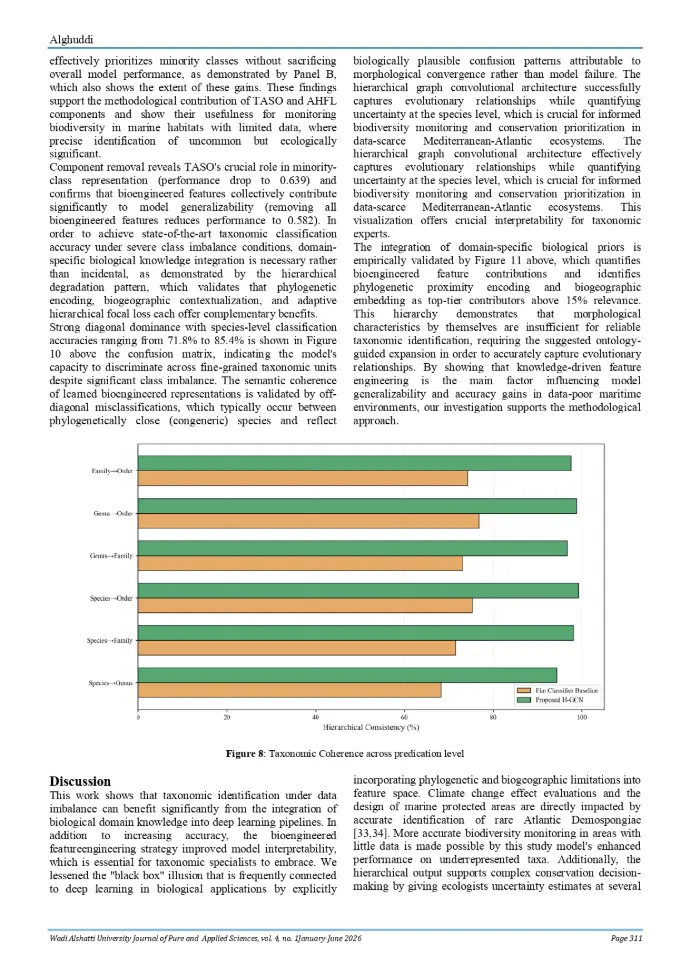
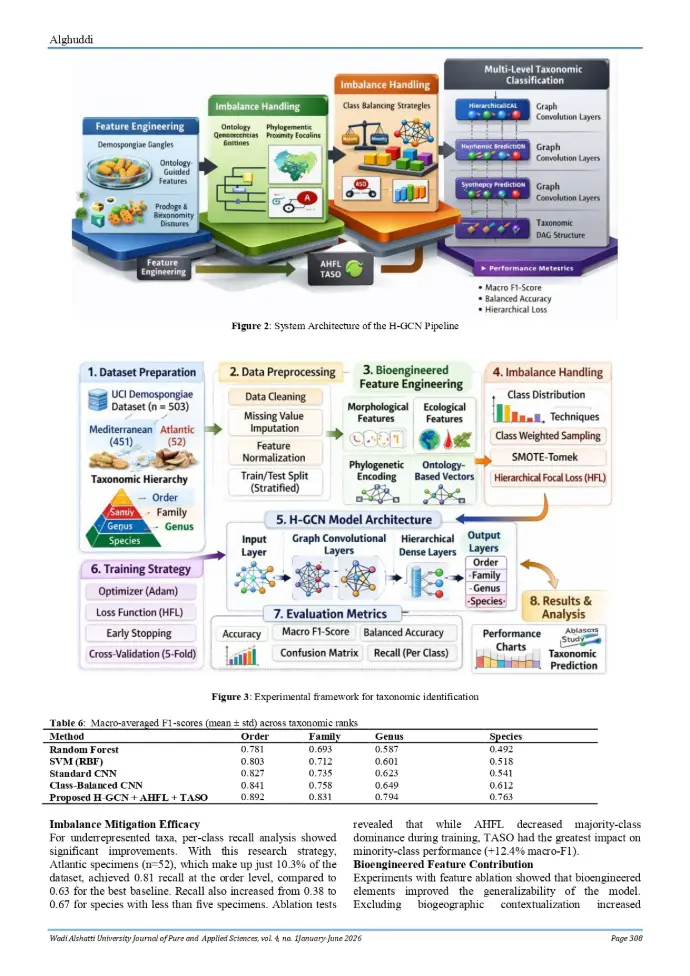
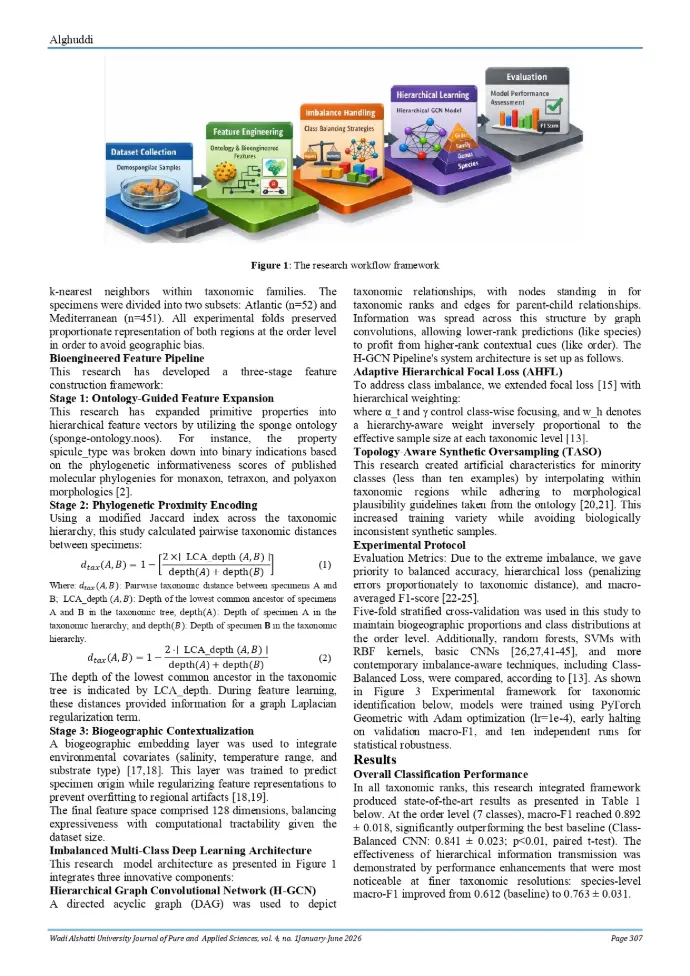
The study addresses the challenges of automated classification of marine sponges (Demospongiae) resulting from morphological similarity and a severe imbalance in regional data. The researcher presented a computational framework that integrates deep learning with feature engineering based on biological foundations to classify 503 samples from the Mediterranean and Atlantic seas. The work included building a feature pathway that encompasses morphological, environmental, and evolutionary information derived from sponge science structures. To address the skewed distribution of data across taxonomic ranks, a hybrid strategy was applied that included artificial oversampling and hierarchical focus loss. A Graph Convolutional Neural Network (H-GCN) was used to learn taxonomic relationships while maintaining hierarchical constraints. The results showed significant superiority over traditional models, achieving an F1 score of 0.89 at the rank level and 0.76 at the species level. The model also recorded a notable improvement in retrieving data for underrepresented Atlantic species. Exclusion analyses demonstrated that integrating biologically engineered features significantly enhances the model's generalization ability. This study contributes to automating classification procedures, thereby supporting more efficient monitoring of marine biodiversity. The research offers a repeatable methodology for integrating human expertise into specialized deep learning systems.
Key features of the research: • The study relied on 49 scientific references. • It was presented in 11 pages in English. • It achieved very accurate results (with an average of 0.89 at the rank level) surpassing traditional models.
To read the full article via the link:https://doi.org/10.63318/waujpasv4i1_33
To browse all the scientific issues of the journal:https://waujpas.com/index.php/journal/issue/archive
Wishing all the best and appreciation to the researcher "Fatima Al-Badawi," and more contributions and academic excellence for our esteemed university.